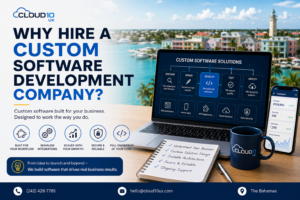
You should hire a custom software development company when off-the-shelf tools can’t fit how your business actually operates — when you need software that scales with growth, integrates your existing systems, protects sensitive data, and gives you full ownership instead of renting a generic platform. Cloud10 UX builds custom web and mobile software for businesses across The Bahamas and the Caribbean, designed to work the way your business works, not the other way around.
Most businesses start with off-the-shelf software — a booking plugin, a generic CRM, a template-based app. It works, until it doesn’t. Growth exposes the gaps: workflows the software wasn’t built for, integrations that don’t exist, and monthly fees that keep climbing while flexibility keeps shrinking.
This is the point where business owners start asking: why hire a custom software development company instead of just adding another plugin or subscription? Below is a clear, practical breakdown — including what’s changed in how software gets found and evaluated online in 2026.
What Is Custom Software Development?
Custom software development is the process of designing and building an application, platform, or system specifically for one business’s requirements — rather than adapting a generic, mass-market product to fit. A custom software development company handles the full lifecycle: requirements discovery, architecture, design, development, testing, deployment, and ongoing support.
The alternative — off-the-shelf (OTS) software — is built to serve as many customers as possible with one shared codebase. That’s efficient for the vendor, but it means every business using it is working within someone else’s constraints.
7 Reasons Businesses Hire a Custom Software Development Company
1. Off-the-Shelf Software Doesn’t Fit Your Exact Workflow
Generic platforms are built for the average user, not your business. Custom software is built around your actual processes — so your team isn’t reshaping how it works to fit software limitations.
2. Integration With Existing Systems
As businesses grow, they accumulate tools: accounting software, booking systems, inventory platforms, CRMs. A custom software development company can build integrations that connect these systems directly, eliminating duplicate data entry and manual reconciliation.
3. Scalability Without Rebuilding From Scratch
Off-the-shelf tools often hit a ceiling — user limits, storage caps, feature restrictions tied to pricing tiers. Custom software is architected to scale with your business, so growth doesn’t force a costly platform migration later.
4. Full Ownership of Your Software and Data
With most SaaS products, you’re renting access — if the vendor raises prices, changes features, or shuts down, your business is exposed. Custom software gives you ownership of the codebase and control over your own data, which matters increasingly for businesses handling customer information, payments, or bookings.
5. Competitive Differentiation
If every competitor in your industry uses the same off-the-shelf platform, none of you can offer anything the others can’t. Custom software lets you build features specific to your customer experience — something a shared, generic tool structurally cannot do.
6. Better Security for Business-Specific Risk
Generic platforms are built to a general security standard because they serve every type of customer. Custom software can be built with security controls specific to your actual risk profile — critical for businesses handling payments, bookings, or sensitive customer data in regulated or high-trust industries.
7. Long-Term Cost Control
Subscription costs for multiple SaaS tools compound over time, and prices are set by the vendor, not you. A custom solution has a higher upfront investment but converts recurring, ever-increasing subscription costs into a system your business actually owns and controls long-term.
Custom Software vs. Off-the-Shelf: Quick Comparison
| Factor | Off-the-Shelf Software | Custom Software Development |
| Fit to your workflow | Generic, requires you to adapt | Built around your actual process |
| Integrations | Limited to what the vendor supports | Built to connect your specific systems |
| Scalability | Capped by pricing tiers | Architected to grow with your business |
| Ownership | You rent access | You own the code and data |
| Differentiation | Same tool as competitors | Unique to your business |
| Cost structure | Lower upfront, rising subscription costs | Higher upfront, long-term cost control |
Signs Your Business Needs a Custom Software Development Company
- You’re using three or more disconnected tools to manage one process
- Your team has built manual workarounds to compensate for software limitations
- You’re paying for software features you don’t use, while missing ones you need
- Your off-the-shelf platform can’t scale past your current user or data volume
- You handle sensitive customer, payment, or booking data with generic security controls
- Competitors using the same platform offer an identical customer experience to yours
If two or more of these apply, a conversation with a custom software development company is worth having before your next subscription renewal.
Why Cloud10 UX for Custom Software Development
Cloud10 UX designs and builds custom web and mobile software for businesses across The Bahamas and the wider Caribbean. Rather than reselling a generic platform, Cloud10 UX works directly with each business to:
- Map your actual workflow before writing a single line of code
- Build integrations with the tools you already rely on
- Architect systems that scale as your business grows, without a rebuild
- Hand over full ownership of the code and data — no vendor lock-in
- Provide ongoing support so your software stays secure and current
For Bahamian and Caribbean businesses outgrowing generic tools, custom software isn’t a luxury — it’s the point where the software finally starts working for the business, instead of the other way around.
Frequently Asked Questions
-
Is custom software development more expensive than off-the-shelf tools?
The upfront cost is typically higher, but many businesses find long-term costs lower because they’re not paying recurring, ever-increasing subscription fees for multiple disconnected tools, and they avoid costly platform migrations as they scale.
-
How long does custom software development take?
Timelines vary widely by scope — a focused internal tool might take a few weeks, while a full custom platform with multiple integrations can take several months. A custom software development company should provide a phased timeline after an initial discovery phase.
-
Can custom software integrate with the tools my business already uses?
Yes — integration with existing systems (accounting, CRM, booking, inventory) is one of the primary reasons businesses choose custom development over off-the-shelf platforms.
-
What’s the difference between custom software and a website?
A website is typically customer-facing marketing and information; custom software refers to applications or systems that run business processes — internal tools, booking platforms, customer portals, or mobile apps. Many businesses need both, built to work together.
-
Do small businesses really need custom software, or is that only for large companies?
Small businesses increasingly need custom software when off-the-shelf tools stop fitting their workflow — the decision point is about workflow fit and growth constraints, not company size.