
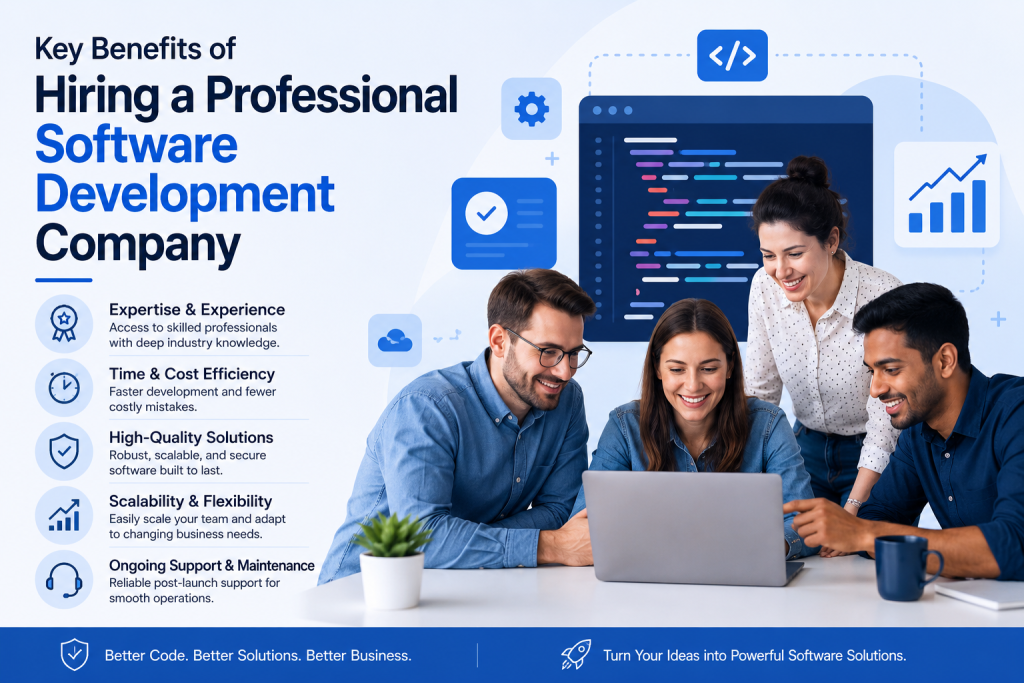
Building software today is far more complex than writing code. It demands architectural foresight, security rigor, cross-platform expertise, and the ability to adapt quickly as requirements shift. Businesses that attempt to manage this entirely on their own often run into cost overruns, missed deadlines, and products that fail to meet user expectations.
“Did you know? According to the McKinsey Global Institute, roughly 17% of large IT projects go so badly that they threaten the very existence of the company that commissioned them. Projects that partner with experienced external software firms are 2.5x more likely to finish on time and within budget compared to those managed entirely in-house.”
Hiring a professional software development company changes that equation entirely. Whether you are a startup launching your first product or an enterprise modernizing legacy systems, a skilled development partner brings structured processes, proven methodologies, and deep technical knowledge to the table giving your project a genuine competitive edge.
This blog covers the most compelling reasons to bring in professional software developers, backed by real industry data, to help you make a confident decision for your business.
Key Takeways
- Professional software firms provide immediate access to multi-disciplinary technical talent without the time and cost of building an internal team.
- Total project costs are typically lower when hidden in-house expenses such as recruitment, attrition, and infrastructure are factored in.
- Structured Agile methodologies used by professional firms accelerate delivery timelines by an average of 38%.
- Built-in QA pipelines and code review processes reduce post-launch defects and long-term maintenance costs substantially.
- Security and compliance expertise embedded in professional development teams protects businesses from financially devastating breaches and regulatory penalties.
- Scalable team structures and cloud-native architecture ensure your software grows with your business without costly re-engineering.
Industry Benchmarks: In-house vs. Professional Development Firms
| Metric | In-house Teams | Professional Dev Firms |
| Avg. Project Cost Overrun | 45–60% | 12–18% |
| On-time Delivery Rate | 54% | 79% |
| Post-launch Bug Rate | High (avg 35 bugs/kloc) | Low (avg 9 bugs/kloc) |
| Avg. Time-to-market | 9–14 months | 4–8 months |
| Tech Stack Breadth | 2–4 languages | 10–20+ technologies |
1. Access to a Broad Pool of Specialized Talent
One of the clearest advantages of working with a professional software development company is immediate access to a wide range of technical specialists. Building an equivalent team from scratch frontend engineers, backend developers, DevOps engineers, QA specialists, UI/UX designers, and security architects can take months and cost a significant premium in salaries, benefits, and onboarding.
A development company already has these professionals working together. Their collaborative experience means fewer handoff errors, faster problem resolution, and higher overall output quality. You get a ready-made, coordinated team without the overhead of recruitment.
Supporting Data:
|
2. Significant Cost Efficiency and Financial Predictability
Contrary to a common misconception, hiring a professional software development company often reduces total project costs rather than increasing them. When you factor in the full cost of building an in-house team recruitment fees, salaries, benefits, licenses, infrastructure, and the hidden costs of attrition outsourcing to professionals frequently delivers better value per output.
Beyond the cost savings, professional firms operate on clearly defined contracts with fixed milestones and deliverables. This structure gives finance teams predictable spending and eliminates the budget ambiguity that comes with managing an expanding internal workforce.
Key Benefits Reported by Businesses — Survey of 1,200 Companies (Clutch.co, 2024)
Percentage of respondents who reported improvement in each area after hiring a professional firm
| Cost Savings | 73% | |
| Faster Delivery | 79% | |
| Higher Quality Code | 81% | |
| Security Compliance | 68% | |
| Scalability | 85% | |
| Access to Expertise | 90% |
3. Faster Time-to-Market Without Sacrificing Quality
Speed matters in today’s product landscape. Getting to market weeks or months earlier than competitors can be the difference between category leadership and irrelevance. Professional software development companies run proven project management frameworks Agile, Scrum, Kanban that keep development cycles tight and reduce wasted effort.
Dedicated teams also work without the distractions that often slow internal resources: support tickets, organizational politics, context-switching between projects. When a firm is contracted to deliver your product, that is their sole focus.
Time-to-Market Data:
|
4. Higher Code Quality and Fewer Post-launch Issues
Software quality is not accidental it is the result of disciplined processes, code reviews, automated testing pipelines, and established quality assurance protocols. Professional software development companies build these practices into every engagement by default.
When code is written without structured QA, businesses typically encounter an expensive second phase of development: bug fixing, performance optimization, and security patching after launch. Studies show that defects caught in development cost 4 to 5 times less to fix than those caught after deployment.
Professional firms use automated test suites, continuous integration pipelines, and peer review processes that dramatically reduce the number of issues that reach production. The result is software that is more reliable, more performant, and significantly cheaper to maintain.
Retated Blog:- How to Choose the Right Software Development Company in 2026
5. Built-in Security and Compliance Expertise
Security is not a feature you add at the end of development it must be embedded from the ground up. Professional software firms employ engineers who stay current with the latest vulnerability databases, OWASP guidelines, GDPR regulations, HIPAA compliance standards, PCI-DSS requirements, and industry-specific security mandates.
Building a product without this expertise is genuinely risky. The average cost of a data breach in 2023 reached USD 4.45 million (IBM Cost of a Data Breach Report). For most businesses, a single significant security incident can cause irreparable reputational and financial damage. A professional development partner treats security as a primary engineering concern, not an afterthought. Companies such as Cloud10 UX prioritize secure development practices from day one.
Security Statistics Worth Noting:
|
6. Scalability On Demand
Business requirements change. A product that handles 500 users today may need to handle 500,000 within eighteen months. Professional software development companies build with scalability in mind architecting systems on cloud-native infrastructure, microservices, and horizontal scaling patterns that grow alongside your user base.
They also offer resource flexibility: you can scale the development team up during intensive build phases and reduce it during maintenance periods, all within the terms of your engagement. This elasticity is simply not achievable with a fixed internal headcount.
7. Ongoing Support, Maintenance, and Technology Evolution
Software is not a one-time deliverable. Operating systems update, browsers release new versions, security vulnerabilities emerge, and user expectations evolve. Professional development companies typically offer structured post-launch support and maintenance agreements that keep your product healthy and current.
Beyond maintenance, a good development partner acts as a long-term technology advisor recommending upgrades, identifying performance bottlenecks before they affect users, and proactively suggesting improvements based on emerging best practices. This continuous relationship transforms your development partner from a vendor into a genuine strategic asset.
Ready to Build Smarter Software with Cloud10 UX?
Choosing the right development partner can determine whether your project becomes a market success or a costly setback. From faster delivery and stronger security to scalable architecture and long-term support, Cloud10 UX helps businesses turn complex ideas into high-performing digital products.
Whether you’re planning a new mobile app, modernizing enterprise software, or launching a scalable SaaS platform, our team is ready to help you move faster with confidence.
Get Started Today
- Discuss your project requirements with our experts
- Receive a tailored development strategy
- Accelerate your product launch with proven methodologies
- Build secure, scalable, and future-ready software
Partner with Cloud10 UX and transform your vision into powerful digital solutions. Contact us today to schedule a free consultation and take the first step toward building software that drives real business growth.
Frequently Asked Questions
Why should businesses hire a professional software development company?
Professional software development companies provide experienced developers, structured workflows, better security practices, and ongoing support that help businesses build reliable and scalable software solutions.
Is custom software better than ready-made software?
Custom software offers better flexibility, scalability, and personalized features based on business requirements. Ready-made software may not fully support unique workflows or future growth needs.
How do software development companies improve security?
Professional companies implement security measures such as encryption, secure coding practices, regular testing, firewall integration, and authentication systems to protect software and user data.
What industries benefit from software development services?
Industries such as healthcare, finance, retail, logistics, education, manufacturing, travel, and real estate benefit greatly from customized software solutions.
Do software development companies provide support after project completion?
Yes, most professional software companies provide maintenance and support services including updates, bug fixing, performance optimization, and security monitoring after deployment.