
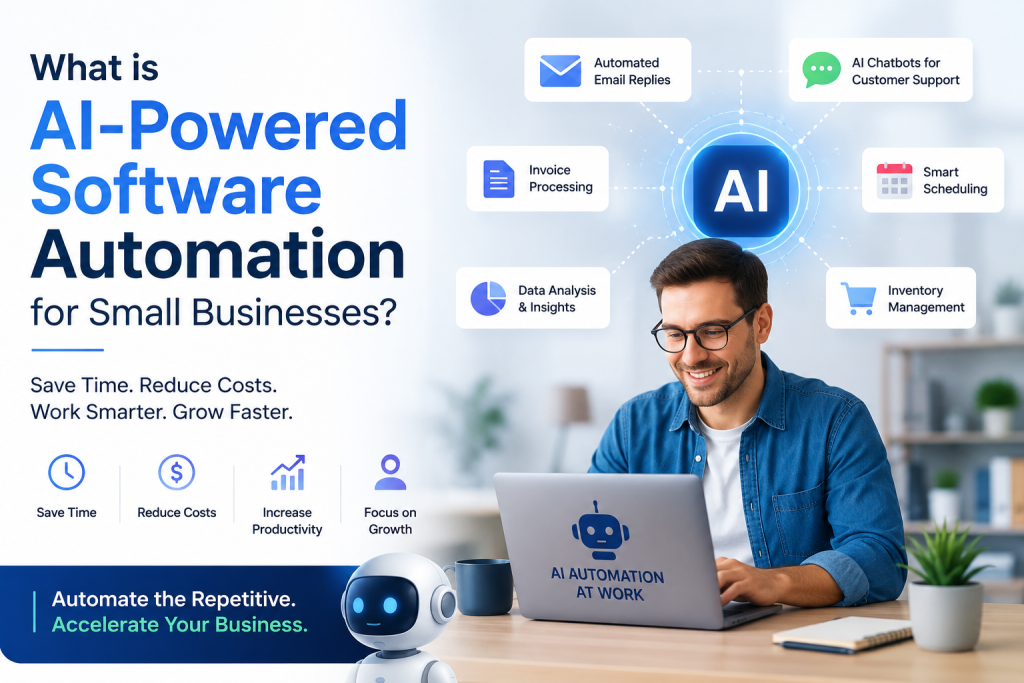
Running a small business in 2026 means wearing too many hats sales, customer service, bookkeeping, marketing, and everything in between. The problem is not motivation or effort. The problem is time. And that is precisely where AI-powered software automation changes the game.
AI automation for small businesses refers to using artificial intelligence tools and AI automation services to perform repetitive, rule-based, or data-intensive tasks automatically, accurately, and at scale without requiring a human to do them manually every time. Think: sending follow-up emails, processing invoices, routing customer queries, scheduling social posts, and flagging inventory shortages. All handled by software. All running in the background while you focus on the work only you can do.
“Did you know? A 2024 study by MIT Sloan found that small business owners who adopted AI automation tools spent 37% less time on administrative work and redirected that time into customer acquisition activities that directly grew revenue. In other words, AI doesn’t just save you time. It redirects your most valuable resource you toward the work that actually moves the needle.”
This blog breaks down how AI automation actually works, what the real-world benefits of AI automation for small business look like, which tools are worth your budget, and how to get started today.
Key Takeways
- AI automation handles repetitive tasks so business owners focus on growth.
- Small businesses using AI report up to 40% reduction in operational costs.
- You don’t need a tech team — most tools are no-code and beginner-friendly.
- From CRM to accounting, AI integration covers every major business function.
- The ROI on AI tools typically appears within 1–3 months of deployment.
- Best AI software for small business includes HubSpot, Zapier, Tidio, and QuickBooks AI.
Why Small Businesses Cannot Ignore AI Automation – The Numbers
Before getting into the mechanics, here is what the data says about AI adoption among small and mid-sized businesses:
| Statistic | Data / Source |
| SMBs using at least one AI tool in 2024 | 35% — up from 23% in 2022 (McKinsey) |
| Time saved per week with AI automation | Up to 13 hours for small business owners (Salesforce) |
| Cost reduction through AI in operations | Average 40% in administrative overhead (Accenture) |
| Businesses reporting higher revenue after AI | 63% saw growth within 12 months (Forbes Advisor) |
| AI customer service chatbot resolution rate | Chatbots handle up to 70% of tier-1 queries (IBM) |
| Small businesses planning to increase AI spend | 74% in 2025 surveys (U.S. Chamber of Commerce) |
| Employee productivity increase with AI tools | Average 14% across knowledge work functions (MIT) |
| Global AI in SMB market size by 2028 | Projected $35.9 billion (MarketsandMarkets) |
Chart: Top Business Areas Where AI Automation Delivers Biggest Impact (% of SMBs)
| Category | Adoption / Impact |
| Customer Support | ████████████████████████████████████████████████████████████████████████████████ 67% |
| Marketing & Email | █████████████████████████████████████████████████████████████████████████ 61% |
| Accounting/Finance | ██████████████████████████████████████████████████████████████████ 55% |
| Sales/CRM | ██████████████████████████████████████████████████████████████ 52% |
| Social Media | █████████████████████████████████████████████████████████ 48% |
| HR & Scheduling | ███████████████████████████████████████████████ 39% |
| Inventory Mgmt | █████████████████████████████████████████ 34% |
Source: Salesforce State of Small Business 2024 / Forbes SMB AI Survey
How AI Automation Works for Small Businesses
The phrase ‘AI automation’ covers a wide range of technologies, but the underlying logic follows a consistent pattern. Here is what actually happens under the hood when you deploy an AI tool in your business:
How AI Automation Works – Step-by-Step Flow
| Step | Stage | What Happens |
| 01 | Data Input | Your business tools (CRM, email, POS) send data to the AI system |
| 02 | AI Processing | Machine learning models analyze patterns, predict outcomes, and decide next actions |
| 03 | Automated Action | The system executes: sends an email, updates a record, generates a report |
| 04 | Feedback Loop | AI learns from each action, improving accuracy over time with zero manual input |
Most AI tools for small businesses abstract all of this complexity behind clean dashboards and simple triggers. You set the rule once — for example, ‘when a new lead fills out this form, send them this welcome email and notify my sales team’ — and the system handles everything else indefinitely.
AI Integration for Small Business: What Areas Can You Automate?
A common misconception is that AI automation only applies to tech companies or enterprises with large IT budgets. The reality in 2026 is very different. Here are the core functions where AI integration for small business delivers measurable results:
1. Customer Support & Communication
AI chatbots and automated response systems handle routine customer queries around the clock. Instead of hiring evening support staff, tools like Tidio or Freshdesk AI manage FAQs, order tracking, appointment confirmations, and basic troubleshooting — all without human input.
2. Marketing Automation
Platforms like HubSpot and Mailchimp’s AI features let you build automated email sequences that respond to customer behavior. A shopper who abandons their cart? They get a reminder. A lead who downloads your guide? They get a nurture sequence. Every action triggered by data, not by you manually clicking ‘send.’
3. Accounting and Financial Workflows
QuickBooks AI, FreshBooks, and Xero now incorporate machine learning to categorize expenses, flag anomalies, predict cash flow, and automate invoice reminders. Tasks that previously required a bookkeeper’s weekly attention now run in real time.
4. Sales and CRM Automation
AI-powered CRMs like HubSpot or Zoho CRM score leads automatically, suggest the best follow-up timing, and log every interaction without sales reps needing to update records manually. This means fewer dropped balls and higher close rates with the same team size.
5. Social Media and Content Scheduling
Tools like Buffer AI and Hootsuite’s AI features analyze your audience behavior, recommend optimal posting times, and even generate caption drafts. Combined with AI writing tools like Jasper, a solo entrepreneur can maintain a consistent content presence that previously required a full marketing team.
6. HR and Scheduling
For businesses with hourly or shift-based staff, AI scheduling tools like 7shifts or Deputy automatically build rosters based on predicted demand, employee availability, and labor compliance rules — saving managers hours of back-and-forth every week.
Manual Process vs. AI Automation – Side-by-Side Comparison
Here is a practical look at how AI automation changes day-to-day operations in a small business:
| Task | Manual Process | With AI Automation |
| Invoice Processing | 3–5 hours/week | Under 10 minutes/week |
| Customer Support | Full-time staff needed | Chatbots handle 70% of queries |
| Social Media Posting | Daily manual effort | Scheduled weeks in advance |
| Inventory Management | Weekly spreadsheet check | Real-time automated alerts |
| Email Follow-ups | Manually written each time | Triggered sequences, auto-sent |
| Appointment Booking | Phone/email back-and-forth | Self-booking with AI scheduler |
Best AI Software for Small Business in 2026
The market for AI tools is crowded, but these are the platforms that consistently deliver the best return on investment for small businesses across different industries:
| Tool Name | Best For | Starting Price | Rating |
| HubSpot CRM | Sales & Marketing | Free–$800+/mo | ★★★★★ |
| Zapier | Workflow Automation | $19–$799/mo | ★★★★☆ |
| QuickBooks AI | Accounting & Finance | $30–$200/mo | ★★★★★ |
| Tidio | Customer Support Chatbot | Free–$499/mo | ★★★★☆ |
| Canva AI | Design & Content | Free–$120/yr | ★★★★☆ |
| Jasper AI | Content Writing | $39–$125/mo | ★★★★☆ |
| Freshdesk | Customer Service | Free–$95/mo | ★★★★★ |
| Hootsuite AI | Social Media | $99–$739/mo | ★★★★☆ |
Note: Pricing as of Q1 2026. Always verify current pricing on vendor websites before purchasing.
Core Benefits of AI Automation for Small Business
Beyond time savings, the benefits of AI automation for small business span every dimension of how you operate, compete, and grow:
1. Drastic Reduction in Human Error
Manual data entry, scheduling conflicts, and missed follow-ups are often costly mistakes in small business operations. AI systems follow rules precisely, every single time. An automated invoice processor will never transpose a number. A CRM workflow will never forget to follow up with a qualified lead.
2. 24/7 Operational Availability
Your business can now respond to customer inquiries, process orders, and send communications around the clock — without overtime costs or weekend staffing. This is particularly valuable for businesses serving international customers or operating across time zones.
3. Scalability Without Proportional Hiring
The traditional growth model requires hiring more staff to handle more work. AI automation breaks this equation. You can double your customer base without doubling your team, because the AI handles the operational volume increase automatically.
4. Deeper Business Insights
AI tools don’t just automate — they analyze. Your CRM tells you which lead sources convert best. Your accounting tool flags unusual spending. Your email platform tells you which subject lines drive opens. Data that would take a dedicated analyst weeks to compile is now available in real time through AI dashboards.
5. Competitive Parity with Larger Businesses
A decade ago, sophisticated marketing automation, 24/7 customer support, and AI-driven lead scoring were only accessible to enterprises with large budgets. Today, a 5-person business can run the same AI-powered customer journey as a 500-person company — at a fraction of the cost.
How to Get Started with AI Integration for Small Business
You don’t need to automate everything at once. Here is a practical, phased approach that works regardless of your industry:
| Getting Started Roadmap |
| Phase 1 — Identify Your Time Drains (Week 1)
Track which tasks consume the most time without requiring your unique judgment. Common culprits: email follow-ups, appointment booking, invoice creation, social posting. Phase 2 — Start with One Tool (Weeks 2–4) Pick one AI tool that directly addresses your biggest time drain. Set it up, use it consistently, and measure the time saved before adding more tools. Phase 3 — Connect Your Tools (Month 2) Use a workflow automation platform like Zapier or Make.com to connect your AI tools — so your CRM talks to your email platform, which talks to your calendar. Phase 4 — Review, Optimize, Expand (Ongoing) Review your AI workflows monthly. Adjust triggers, update sequences, and identify the next business function ready for automation. |
Ready to Put AI to Work in Your Business?
At Cloud10 UX, we help small businesses design and implement AI-powered workflows that actually fit the way you work — not generic templates that collect dust.
Here’s what Cloud10 UX offers small business owners like you:
✅ Free AI Readiness Audit — We map your current workflows and identify exactly where automation saves you the most time.
✅ Done-For-You AI Integration — Our team sets up and connects the right tools for your CRM, marketing, support, and finance — no tech overwhelm.
✅ Ongoing Optimization — We monitor, tweak, and improve your automations every month so they keep delivering results as your business grows.
AI-powered software automation is not a future trend for small businesses — it is a present-day operational advantage. Whether you start with a simple email sequence or deploy a full CRM automation stack, every hour you reclaim from repetitive tasks is an hour you can spend on strategy, customer relationships, and the work that truly builds your business.
The tools are affordable. The learning curve is manageable. The competitive advantage is real. The only question is: when do you start?
Frequently Asked Questions
Is AI automation affordable for very small businesses?
Yes. Many AI tools offer free tiers or low-cost entry plans — Tidio starts free, Zapier costs $19/month, and HubSpot CRM is completely free. You can start automating for under $50/month and scale as your needs grow.
Do I need technical skills to implement AI automation?
Not at all. Most modern AI tools for small businesses are built with no-code or low-code interfaces. Platforms like Zapier, HubSpot, and Freshdesk use drag-and-drop workflows that any business owner can set up in a few hours.
How long does it take to see results from AI automation?
Many small businesses see immediate time savings within the first week of deployment. ROI typically becomes measurable within 1–3 months, especially in areas like customer support, email marketing, and invoice processing.
What are the best AI software options for small businesses in 2026?
Top choices include HubSpot (CRM and marketing), Zapier (workflow automation), QuickBooks AI (accounting), Tidio (customer chat), and Jasper AI (content creation). The best fit depends on your specific business function.
Is my business data safe with AI tools?
Reputable AI platforms comply with data protection regulations like GDPR and CCPA. Always check a vendor’s security certifications, data encryption standards, and privacy policies before integration. Avoid connecting sensitive financial data to unverified tools.